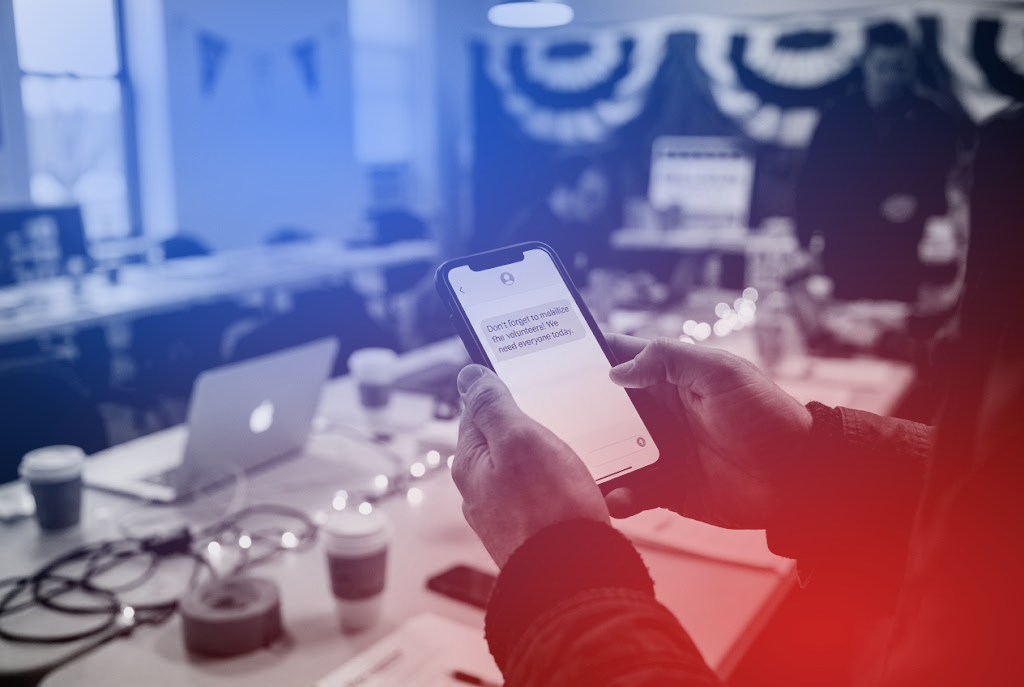
Political texting is how campaigns, committees, and advocacy groups reach voters directly by text message, over SMS, MMS, and increasingly RCS, to persuade them, turn them out, raise money, and recruit volunteers. It works for one blunt reason: a text gets read. More than 90% of texts are opened within minutes of arriving, while email open rates sit around 20% and a cold phone call mostly goes to voicemail. For a campaign that has to move a specific number of votes in a specific district, that reach is the whole argument.
This guide covers what political texting actually is, the two formats campaigns use, what each is good for, what it costs, the rules that govern it, and how to start a program that lands instead of getting filtered.
What is political texting, exactly?
Political texting is direct-to-voter communication by text message as part of a campaign or advocacy effort. In practice it means a campaign builds a list of contacts who've consented, writes a message, and sends it through a platform that handles carrier registration and compliance so the messages arrive. The good programs treat the replies as conversations, not dead ends, because the reply is where persuasion and data both happen.
It is not spam, and it is not a blast to a purchased list. Done right, every number on the list opted in, every message identifies the sender, and every opt-out is honored instantly. Done wrong, it's a lawsuit and a filtered sender reputation. The difference between those two outcomes is almost entirely about consent and compliance, which is why so much of political texting is really about the plumbing underneath the message.
What are the two types of political texting?
There are two formats, and serious campaigns run both because they do different jobs.
| Format | How it works | Best for | Trade-off |
|---|---|---|---|
| Broadcast | One message sent to a whole opted-in list at once, automated | GOTV reminders, event announcements, fundraising asks | Fast and scalable, but needs express opt-in and can feel impersonal |
| Peer-to-peer (P2P) | A real person sends each message individually from a queue | Persuasion, voter ID, volunteer recruitment, follow-up | Conversational and higher-reply, but slower and needs people |
Broadcast texting sends one message to many at once. It's the workhorse for reaching an opted-in list quickly, a GOTV reminder the night before an election, an event invite, a fundraising ask to supporters. It scales to a whole list in minutes, and it expects a clean opt-in because it's automated.
Peer-to-peer texting has a volunteer or staffer send each message one at a time. Because a human initiates every send, it sits outside the strict autodialer rules, which is why campaigns use it for first contact and persuasion where a prior opt-in may not exist. It's slower and needs people, but the reply rates are far higher, and a single volunteer can hold a couple hundred real conversations in an afternoon.
What do campaigns use political texting for?
The use cases map to the phases of a campaign:
- Persuasion. One-on-one conversations, often by P2P, to make the case to undecided voters. A text like "Hi, I'm a volunteer with the Hardin campaign, can I ask what issue matters most to you?" opens a door a mailer never will.
- Voter ID and surveys. Single-question polls and issue surveys that tag a contact by their answer, so the next message is relevant.
- Volunteer recruitment. Texting supporters to fill shifts, canvasses, and phone banks.
- Fundraising. Direct asks with a giving link, especially around deadlines, where text's speed and open rate outperform email.
- Get-out-the-vote. The final-stretch reminders, ballot-chase for early and mail voters, polling-location and hours texts on Election Day.
Texting rarely stands alone. It works best woven into a program, text responses that trigger a phone-bank follow-up, RSVPs that flow into event management, survey answers that sharpen the next send.
Why do campaigns text instead of email or call?
Because it's the one channel that reliably reaches people where they already are. The numbers make the case. Texts see open rates above 90% within minutes; email struggles to break 20%. Click-through on SMS runs several times higher than email. And unlike a robocall, a text lets a voter reply, which turns a broadcast into a conversation and a conversation into data.
There's a scale point too. In a recent cycle, Americans received an estimated 15 billion political texts, roughly 50 per person. That volume is a signal: campaigns aren't texting because it's novel, they're texting because it's the most effective voter-contact channel available, and the ones who do it well pull ahead of the ones who treat it as an afterthought.
Is political texting legal?
Yes, when it's done right. Political campaigns get more room than commercial marketers, but they are not exempt from the rules. Every compliant political text meets four requirements: it has consent, it honors opt-outs instantly, it identifies the sender, and it's sent during reasonable hours. On top of that, the campaign has to register with the carriers through 10DLC so the messages actually deliver.
The consent piece trips people up most. Campaigns don't need the signed, prior express written consent a retailer needs, but they do need some consent, and a voter file or a purchased list is not consent. For the full treatment, see what consent a campaign actually needs and the deeper TCPA guide.
How much does political texting cost?
It depends on volume and format. Broadcast is priced per message, so cost scales with list size and send frequency. Peer-to-peer adds the cost of the people sending, since a human touches every message. The bigger and less obvious cost is deliverability: unregistered or non-compliant traffic gets filtered by the carriers, which means money spent on messages nobody sees. A cheap send that doesn't land is more expensive than a compliant send that does.
The practical way to budget is to size your monthly volume, pick a plan that covers it, and treat compliance and registration as non-negotiable line items rather than corners to cut.
How do you start a political texting program?
Four steps, in order:
- Register first. Complete 10DLC brand and campaign registration, and for 527 traffic, Campaign Verify. Nothing textable works until this clears, so start early. See what 10DLC means for your campaign.
- Grow a consented list. Use QR codes, keywords, pledge pages, and relational outreach to get voters to opt themselves in. Don't buy a list.
- Pick your format per goal. Broadcast for the opted-in list, P2P for persuasion and cold-ish first contact. Most programs use both.
- Build compliance in, not on. Automatic STOP and HELP handling, sender ID in every message, quiet hours by recipient local time, and record retention.
Frequently asked questions
What is political texting?
Political texting is direct-to-voter communication by SMS, MMS, or RCS as part of a campaign or advocacy effort, used to persuade voters, turn them out, raise money, and recruit volunteers. It comes in two formats: broadcast (one message to a whole opted-in list) and peer-to-peer (a person sends each message individually).
Is political texting effective?
Yes. Texts are opened at over 90% within minutes versus around 20% for email, and they let voters reply, which turns outreach into conversation. Campaigns sent an estimated 15 billion political texts in a recent cycle precisely because it's the most reliable voter-contact channel.
Do you need consent to text voters?
Yes. Campaigns are exempt from the signed written-consent rule that binds commercial marketers, but they still need some form of consent. A voter file or a purchased list is not consent.
What's the difference between P2P and broadcast texting?
Broadcast sends one message to a whole list automatically and needs express opt-in. P2P has a person send each message individually, which suits persuasion and first contact and sits under a different consent standard because a human initiates each send.
Keep reading: P2P vs broadcast, which one and when and how to grow a texting list that's actually yours. For background on the rules, see the FCC's telemarketing and robocall rules.